With the rapid development of advanced manufacturing and precision electronics, plasma cleaning technology—valued for its efficiency, eco-friendliness, and non-destructive nature—is seeing increasingly widespread use in surface treatment. Plasma cleaners ionize gases (such as compressed air, oxygen, or argon) into plasma using a high-frequency electric field. The active particles in the plasma then physically bombard and chemically react with the material surface to achieve cleaning, activation, and modification. Compared to traditional wet cleaning methods, plasma cleaning requires no chemical solvents, avoids hazardous emissions, improves cleaning efficiency by over 30%, and leaves no secondary contamination. However, faced with the wide variety of plasma treatment equipment on the market, many users find the selection process confusing. This article aims to clarify the selection logic by examining equipment types, technical specifications, and application scenarios.
I. Distinguishing Between the Two Main Types of Plasma Cleaners
From an operational environment perspective, plasma cleaners are primarily divided into two categories: Atmospheric Pressure and Vacuum systems. The differences in principle, cost, and suitable applications are significant, and the first step in selection is understanding this fundamental distinction.
Atmospheric pressure plasma cleaners generate plasma directly in an open environment. They require no vacuum pump or sealed chamber, allowing for immediate use and convenient operation. The primary advantages of this type are lower cost and faster processing speed. They are particularly well-suited for assembly line operations and applications where ultra-high cleanliness is not the primary requirement—for instance, surface preparation of mobile phone casings prior to printing or activation of plastic parts before bonding, often capable of processing dozens of workpieces per minute.
Vacuum plasma cleaners require the plasma to be generated inside a sealed chamber after evacuation, completely isolating the process from the external environment. The key benefit of this closed environment is exceptionally high treatment uniformity (often exceeding 99%), making it suitable for highly sensitive components such as semiconductor wafers and medical catheters. The trade-off includes higher equipment costs (including the vacuum pump system) and the time required for pump-down cycles before each batch, necessitating a careful balance between throughput and precision requirements.
In short: For high-volume, fast-paced applications with standard precision requirements, prioritize atmospheric pressure systems. For high-precision, high-value-added products that can tolerate batch processing cycles, vacuum systems are more appropriate. If unsure, it is recommended to arrange sample testing with the manufacturer to verify the actual results.
II. Handheld Atmospheric Plasma Cleaners: A Practical Solution for Flexible Processing
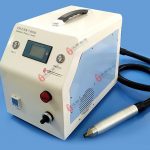
Within the category of atmospheric pressure plasma cleaners, there is a specific form factor worth discussing separately—the handheld plasma cleaner. Taking the Suzhou Wenhao WH-HPC-01, independently developed by Wenhao Co., Ltd., as an example: This device uses a plasma generator to produce high-voltage, high-frequency energy. Low-temperature plasma is generated via controlled glow discharge within the nozzle tube, and compressed air propels the plasma jet onto the workpiece surface. This process significantly enhances surface adhesion, compatibility, and wettability.
Key Technical Specifications Overview:
| Parameter | WH-HPC-01 Specification |
|---|---|
| Input Power | AC 220V ±10% / 50Hz |
| Max Input Power | 550W |
| Max Output Voltage | AC 10KV |
| High-Voltage Frequency | 25KHz |
| Output Power Range | Adjustable 400W – 500W |
| Input Air Pressure | 0.4 MPa – 1.0 MPa |
| Recommended Working Pressure | 30 KPa (Range: 25 – 60 KPa) |
| Flame Temperature | 200°C |
| Plasma Treatment Width | 10 mm (15 mm optional, other customizations available) |
| Continuous Operation Time | 20 minutes |
| Main Unit Weight | 8 kg |
| Gun Head Weight | 0.5 kg |
| Gas Consumption | 120 L/min (at 30 KPa) |
| Main Unit Dimensions | 465 (L) x 230 (W) x 300 (H) mm |
The core advantage of the handheld format lies in its flexibility and portability. With the main unit weighing only 8 kg and the gun head a mere 0.5 kg, the compact design does not occupy a fixed workstation and can be easily moved between different work areas as needed. It is particularly suitable for laboratory R&D, small-batch/high-mix production, and scenarios requiring localized, targeted treatment.
Typical Application Scenarios:
-
Microfluidic Chip Bonding — This is one of the core applications of the WH-HPC-01. In microfluidic chip fabrication, plasma treatment significantly increases the hydrophilicity of polymer materials like PDMS by introducing polar groups (such as hydroxyl groups) to the surface, making it easier for bonding media to wet the chip. Experiments show that the contact angle of PDMS surfaces treated with plasma cleaning can drop from >90° to below 30°, increasing bonding success rates to over 95%. Furthermore, plasma treatment effectively removes photoresist residues and metallic contaminants, providing a clean surface for reliable bonding.
-
Electronics Industry — Pre-treatment for mobile phone case printing, coating, and dispensing processes, as well as surface treatment of phone screens to enhance coating adhesion through improved wettability.
-
Defense Industry — Surface cleaning of precision components such as aerospace electrical connectors.
-
General Industry — Pre-treatment for screen printing and pad printing, and surface activation prior to bonding various materials.
It is important to note that the WH-HPC-01 utilizes compressed air as the process gas, which is cost-effective and readily available. However, atmospheric plasma treatment can be affected by ambient humidity and other environmental factors, potentially resulting in slightly less uniformity compared to vacuum systems in applications demanding the highest precision. This should be considered during the selection process based on specific process tolerances.
III. Key Steps and Parameter Considerations for Selection
Regardless of the type of plasma cleaner being considered, the following steps can guide you toward a well-informed decision:
Step 1: Define the Object and Requirements.
Clearly identify the material type to be treated (metal, plastic, glass, ceramic, polymer, etc.), the workpiece geometry (flat or complex structure), and the objective of the treatment (cleaning/contaminant removal or surface activation/modification). For instance, activation of PDMS polymers often favors oxygen plasma, while metal oxide removal requires a combination of physical bombardment effects.
Step 2: Assess Throughput and Processing Method.
For small-scale R&D and laboratory use, benchtop or handheld equipment is generally more suitable. For high-volume production lines, inline or automated integrated solutions should be considered.
Step 3: Focus on Core Technical Indicators.
Power output directly influences plasma density and treatment speed, but material compatibility must be considered (sensitive materials may not tolerate excessive power). Additionally, evaluate gas control precision, electrode material and lifespan, and equipment safety certifications (e.g., CE, UL).
Step 4: Evaluate Long-Term Operating Costs.
The initial purchase price is only part of the total cost. Consider ongoing expenses such as gas consumption, electricity usage, vacuum pump maintenance (if applicable), and the replacement frequency of consumables like electrodes.
IV. Suitability Boundaries and Selection Recommendations for WH-HPC-01
This device is suitable for the following scenarios:
-
Microfluidic chip R&D and fabrication (e.g., PDMS bonding)
-
Small-batch laboratory sample processing
-
Workspaces requiring mobility and flexibility
-
Localized surface treatment of consumer electronics housings and screens
-
Pre-treatment for printing, coating, and bonding processes
-
Applications where compressed air meets process gas requirements
The following scenarios may warrant consideration of alternative solutions:
-
High-precision, high-uniformity semiconductor wafer-level cleaning — Consider vacuum RF or microwave plasma cleaners.
-
High-volume continuous production lines — Consider inline atmospheric plasma systems.
-
Precision surface modification requiring specialty gases (oxygen, argon, etc.) — Consider vacuum systems supporting multi-channel gas control.
-
Applications demanding the highest cleanliness levels and able to accommodate batch processing — Vacuum plasma cleaners typically yield superior results.
Conclusion
There is no “one-size-fits-all” answer when selecting a plasma cleaner; the key lies in matching the equipment to your specific requirements. Before purchasing, clearly define the material properties, geometry, precision needs, and throughput expectations of your application. Communicate these details thoroughly with the manufacturer and, if possible, provide samples for trial processing. Additionally, consider factors such as after-sales service, spare parts availability, and operator training support.
Suzhou Wenhao Co., Ltd. possesses extensive experience in the microfluidics field. The WH-HPC-01 handheld plasma cleaner, as an independently developed product, has accumulated significant application expertise in niche areas such as microfluidic chip bonding. If you are engaged in microfluidic chip R&D or related surface treatment work, you are welcome to learn more about the specific performance and applicability of this device, or contact our technical team to arrange sample testing services.